 Express Transcript
Why People Switch to AI Transcription
I am not writing this as a vendor checklist. I am writing it as someone who got tired of losing time after recordings were already done. The recording part was easy. The annoying part was everything after: fixing names, cleaning broken sentences, and figuring out if paying for transcription every week made financial sense.
So this is the guide I wanted before I spent money. No broad template language. No fake stats. Just the two things most of us care about: what it really costs, and whether the transcript is usable enough that we do not need a second job editing it.
The short version: if a tool is cheap but needs heavy cleanup, it is not really cheap. If a tool is accurate but too expensive to use regularly, it also fails in real life.
Why I stopped thinking about "features" first
I used to compare tools by feature pages. Big mistake. Every service says it supports many languages, exports, timestamps, and speaker labels. On paper, they all look close.
In real use, one transcript can take 8 minutes to finalize, another can take 35 minutes, even if both were generated quickly. That is why I now compare only one thing first: total time from upload to final version I can share without embarrassment.
The pricing reality most people only notice after month one
Pricing is where this decision gets real. Not because cheaper is always better, but because price decides whether you transcribe consistently or only when something feels "important enough."
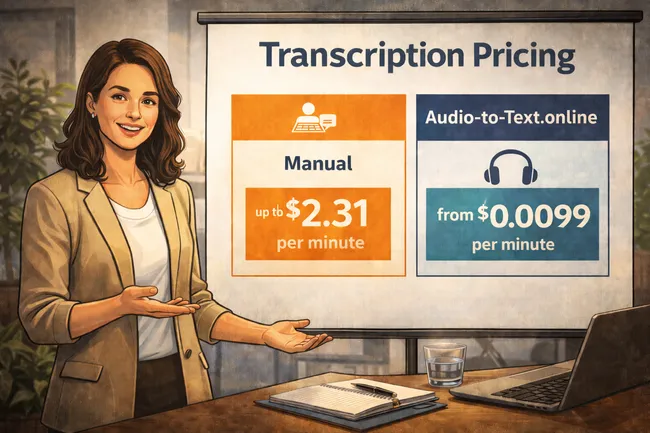
As of February 10, 2026, one public manual rate reference shows pricing up to $2.31 per minute. On the other side, audio-to-text.online pricing can start at $0.0059 per minute.
That gap changes behavior immediately. If I only transcribe occasionally, I miss context. If I can afford to transcribe everything I actually need, my notes become consistent and I stop replaying recordings all week.
Simple math you can run in 30 seconds
Manual side below uses up to $2.31/min. Right side shows plan pricing examples from audio-to-text.online.
| Monthly recorded minutes | Manual transcription (up to $2.31/min) | audio-to-text.online plan price |
|---|---|---|
| 1,000 minutes | $2,310.00 | $14.90 |
| 3,000 minutes | $6,930.00 | $39.00 |
| 10,000 minutes | $23,100.00 | $59.00 |
This does not mean manual is "bad". It means manual often becomes a selective workflow. AI becomes a routine workflow. For me, routine won because I wanted fewer memory gaps, not just one perfect transcript per month.
Where quality actually breaks (and what I now test first)
Most transcript mistakes are predictable. I check these before trusting any tool:
- Two people talking over each other during key decisions.
- Fast speakers with low-volume mics.
- Long recordings where timestamps start drifting later.
- Names and speaker labels changing mid-file.
- Exports that look fine in TXT but break in subtitle formats.
If a tool handles those reasonably well, everything else is usually manageable.
My personal 15-minute test (copy this exactly)
- [ ] Use one difficult real recording, not a clean sample clip.
- [ ] Measure minutes from upload to first readable transcript.
- [ ] Count speaker-label fixes in overlapping speech moments.
- [ ] Check timestamps near start, middle, and near the end.
- [ ] Track edit minutes needed until the file is share-ready.
- [ ] Export what you really need (TXT, DOCX, SRT, or VTT).
- [ ] Decide only after that test, never before.
This test gave me better answers than hours of reading "best tool" posts.
What changed for me after moving to audio-to-text.online
The biggest change was not only cost. It was consistency. I stopped debating whether each recording was worth transcribing. I just processed files and moved on.
Second, cleanup became predictable. I still edit, but it is targeted editing, not rescue editing. That difference sounds small until you do it every week.
Third, sharing improved because exports were ready for the next step instead of forcing random conversions. For normal day-to-day work, that is a big deal.
Honest part: what still needs human attention
Even good AI transcription is not magic. I still review names, punctuation in long monologues, and critical lines where one word changes meaning. Anyone promising zero review is selling fantasy.
But there is a huge difference between light review and full rewrite. Light review is realistic. Full rewrite defeats the point.
If you are undecided, do this one tie-break test
Take your ugliest recording. Bad mic, interruptions, multiple speakers. Run it through your current method and one AI tool. Time both workflows end to end. The winner is whichever gets you to final shareable output faster, with less frustration, at a price you can keep paying every month.
That is the only comparison that really matters.
FAQ: Personal questions people actually ask
Do I still need to edit AI transcripts?
Yes, but usually light edits. The goal is fast cleanup, not perfect raw output.
Is manual transcription ever worth it?
For some high-stakes files, yes. But for regular recurring recordings, AI is usually more practical.
Why mention price so directly?
Because price controls usage behavior. If it is too expensive, most people transcribe less often.
How many files should I test before deciding?
At least two difficult recordings from different contexts.
What should I optimize for first: speed or accuracy?
Optimize for total edit time to final output. That blends both in one real metric.
Can this work for one person, not a company?
Yes. This guide is written exactly for that normal-person workflow.
Try one hard file before you buy anything
Do not start with your easiest recording. Start with the messiest one and compare total edit time, quality, and cost side by side.
Start with a real test file